Compare the punting tours
Shared, private and student-guided punts along the Backs, side by side.
Guide · the College Backs · Cambridge
The Backs are the reason people punt Cambridge at all: the river running behind the old colleges, past chapels and lawns and centuries-old bridges you simply cannot see this way on foot. Here is the whole route, in order.
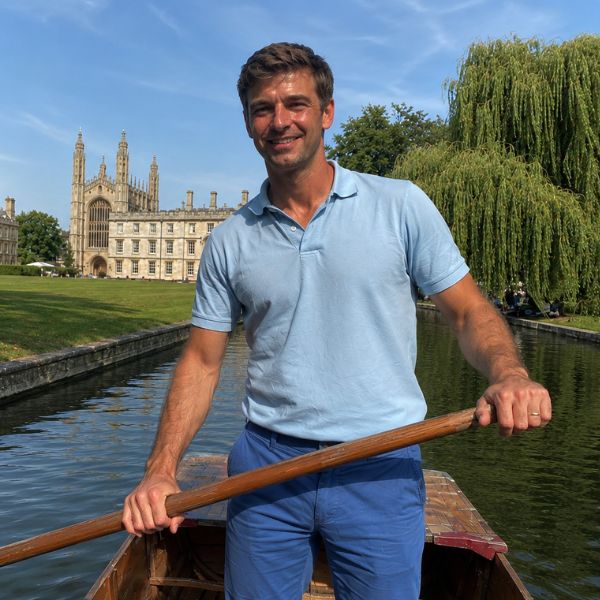 Written and guided by Jordan Harrington, Cambridge punting guide since 2021
The short answer
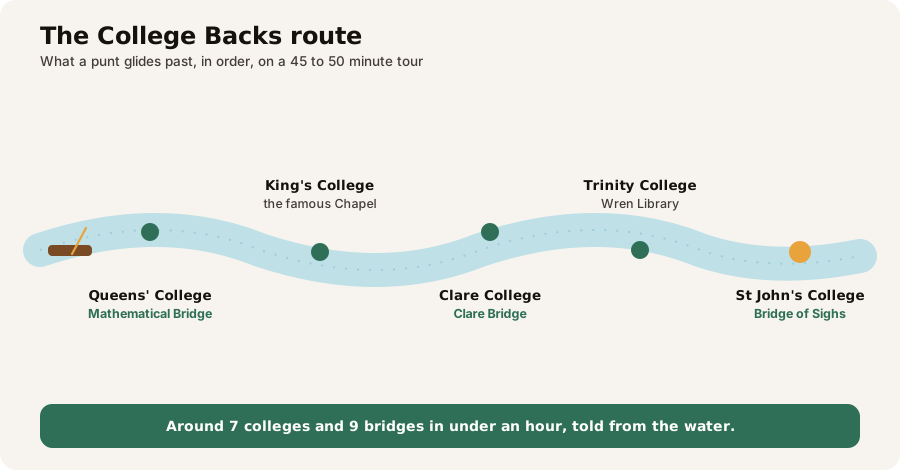
The College Backs are the stretch of the River Cam that runs behind the historic Cambridge colleges. A guided punt glides past them in about 45 to 50 minutes, passing around seven colleges and nine bridges. Going south to north you pass Queens' College and the Mathematical Bridge, King's College and its chapel, Clare College and Clare Bridge, Trinity College, then St John's College and the Bridge of Sighs.
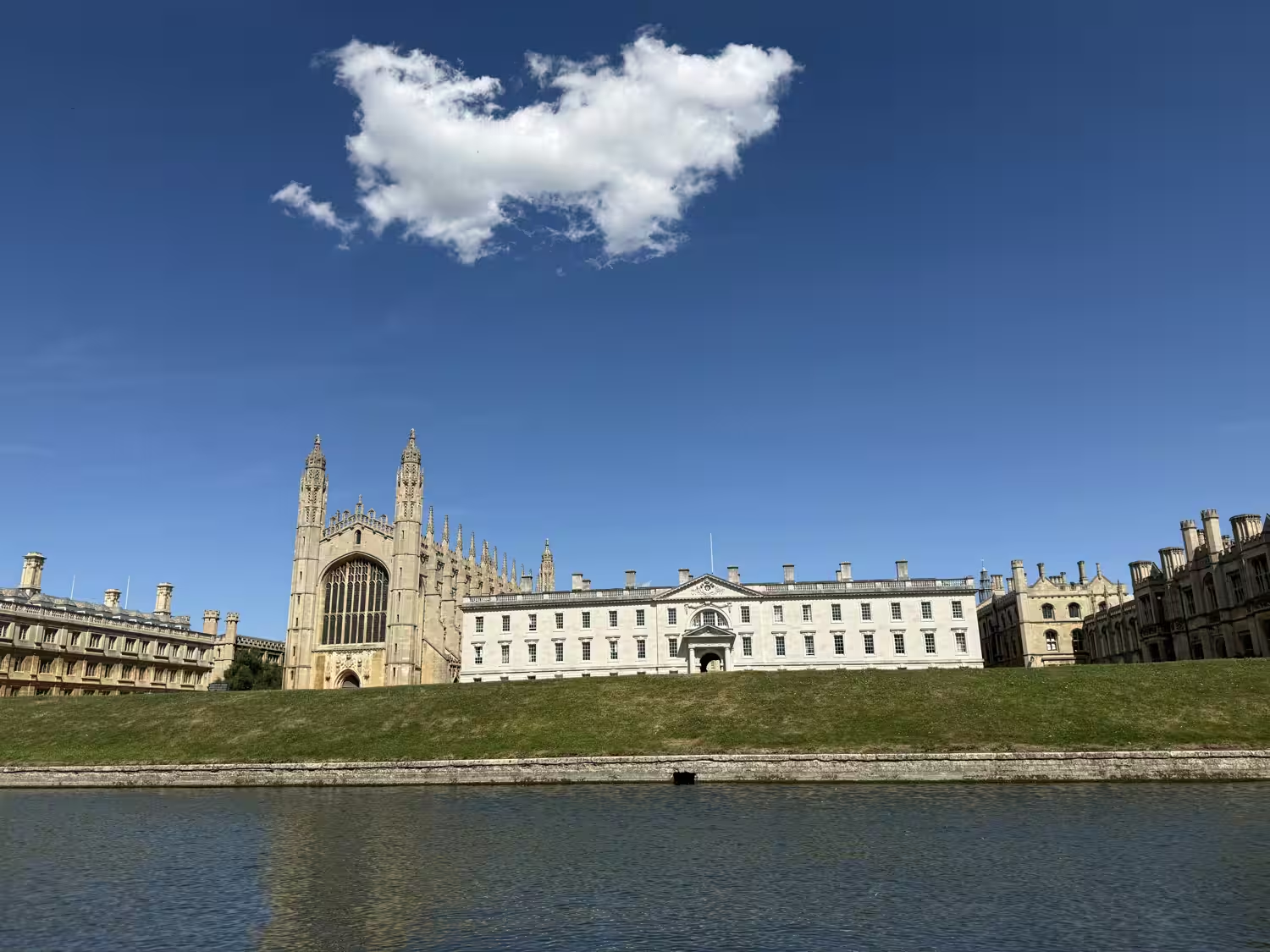
The Backs are the stretch of the River Cam that runs behind a line of the old Cambridge colleges, where their lawns, gardens and grand stone buildings come right down to the water. It is the view Cambridge is famous for, and a guided punt is the only way to see all of it in one go.
On foot you catch the colleges from the front, off the busy streets. From a punt you see the side almost nobody photographs from anywhere else: the back lawns, the chapel rising over the river, the bridges that link one bank of a college to the other. The word Backs simply means the backs of the colleges, and the green open land behind them along the Cam.
A standard chauffeured tour covers the core run in about 45 to 50 minutes, there and back, with the guide poling and telling the stories while you sit and look up. You do not need to steer, balance or paddle. For how that tour actually feels and what to expect on the day, see our shared punting tour page.
Most guided punts work the Backs from south to north, starting near Queens' College and turning around past St John's. In order you pass Queens' College and the Mathematical Bridge, King's College and its chapel, Clare College and Clare Bridge, Trinity Hall, Trinity College, then St John's College and the Bridge of Sighs.
Tours run from different stations, so your exact start point and direction can vary, but the cast of colleges and bridges is the same. Here is the core run and what to look for at each college.
| College (south to north) | What to look for |
|---|---|
| Queens' College | The wooden Mathematical Bridge over the Cam, and the red-brick Tudor buildings on both banks |
| King's College | King's College Chapel, the great Gothic landmark, seen rising over the back lawn from the water |
| Clare College | Clare Bridge, the oldest on the Backs, and the formal Fellows' Garden behind it |
| Trinity Hall | One of the smaller, older colleges, tucked between its larger neighbours on the riverbank |
| Trinity College | The largest college, with the Wren Library along the river and Trinity's own bridge |
| St John's College | The Bridge of Sighs and the older Kitchen Bridge, with the New Court turrets behind |
Colleges in the order a typical south-to-north Backs tour passes them. Your station and direction may shift the start point.
The first stretch is the busy, postcard part: Queens', King's and Clare follow each other quickly, so the famous shots come early. By the time you reach Trinity and St John's the river usually opens up a little, and the bridges do the talking.
Three bridges get asked about more than all the others put together: the Mathematical Bridge at Queens', the Bridge of Sighs at St John's, and Clare Bridge, the oldest of the lot. They are the moments most people remember from the water.
The Mathematical Bridge is the wooden footbridge at Queens', built in 1749 to a design by William Etheridge. The famous legend says Isaac Newton built it without a single nail, that students later took it apart to study it, and that they could not put it back together, so they had to add bolts. It is a good story and it is not true: Newton died in 1727, well before the bridge existed, and it has always used fixings. The clever part is real though, the way the straight timbers are arranged so the load runs along them in a curve.
The Bridge of Sighs at St John's is the covered stone bridge built in 1831 that crosses the Cam to join two of the college's courts. It takes its nickname from the Venetian bridge it loosely recalls, and Queen Victoria is said to have loved it. From a punt you glide almost underneath it, which is the angle that makes the photo.
Clare Bridge, built in 1639 and 1640, is the oldest surviving bridge on the Backs. It is a low three-arched stone bridge topped with decorative stone balls, one of which famously has a wedge cut out of it, with several stories told about why. Quieter than the other two, it is often the prettiest in soft light.
| Bridge | College | Why it's famous |
|---|---|---|
| Mathematical Bridge | Queens' | Wooden 1749 design with a tall-tale Newton legend that is not true |
| Clare Bridge | Clare | Oldest surviving bridge on the Backs, 1639 to 1640, with its stone balls |
| Bridge of Sighs | St John's | Covered 1831 bridge named after the Venetian one; the classic St John's view |
| Kitchen / Wren Bridge | St John's | The older 1712 bridge just downstream of the Bridge of Sighs |
| Trinity Bridge | Trinity | The stone bridge by Trinity's grounds and the Wren Library stretch |
A College Backs run passes around nine bridges in total; these are the ones visitors ask about most.
The best shots on the Backs are the ones you can only get from a punt: King's College Chapel framed over the back lawn, the underside of the Bridge of Sighs, and the wooden curve of the Mathematical Bridge low against the water. A good guide times the route so they land in decent light.
The single most-wanted photo is King's College Chapel from the river. From the bank you fight crowds and railings; from the water the chapel sits clean above the green lawn with nothing in front of it. Have your camera ready before you reach it, because the punt does not stop. The river gives you that clean outside view; to step inside the chapel itself, an alumni-led walking tour that includes King's College entry can be checked here.
For the Bridge of Sighs, the trick is the approach: shoot it as you glide toward and then under it, not after, when you are looking back at its plain side. The Mathematical Bridge rewards a low angle, which is exactly what the punt gives you. Here is where to be ready on each stretch.
| Stretch | Highlight / best shot |
|---|---|
| Queens' (start) | Low shot of the Mathematical Bridge as you pass beneath it |
| King's | King's College Chapel rising over the back lawn, the classic Cambridge view |
| Clare | Clare Bridge and its stone balls, prettiest in soft, low light |
| Trinity | The Wren Library along the riverbank and Trinity's open lawns |
| St John's (turn) | The Bridge of Sighs head-on as you approach and pass under it |
Highlights by stretch, in the order a south-to-north tour reaches them.
Go early. The Backs are quietest in the early morning, with soft light, far fewer punts on the water and room to actually take in each college. They are busiest midday in summer and on weekends, when the river fills with traffic.
Punting runs year-round in Cambridge except Christmas Day, but the season people mean is roughly spring to autumn. Late spring and early autumn are the sweet spot: good weather, longer light, and a calmer river than peak summer. If you can only go in summer, the first departures of the day and the late afternoon are far better than the midday crush.
Light matters as much as crowds on the Backs. Early and late, the low sun warms the stone and throws the bridges into relief, which is when Clare Bridge and the chapel look their best. For a full month-by-month read on weather, crowds and the calmest times, see our guide to the best time of year to punt.
Book your punt
Shared, private and student-guided punts run daily along the College Backs. See the live price and free-cancellation terms on the operator's official listing before you pay.
Check live availability & prices →4.7 · 1,521 reviews · free cancellation up to 24 hours
The punt itself runs about 45 to 50 minutes. Door to door, allow closer to an hour and a half once you add finding the station, checking in, waiting for the boat to reset and walking back into town. Most visitors find a Backs punt sits comfortably inside a half day.
The gap between those two numbers is what catches people out. The listing says 50 minutes, so the next thing goes in the diary 50 minutes later, and then the previous group is still stepping off and nobody has moved. Boarding is deliberately unhurried: the punt sits low, it shifts as you step down, and people go one at a time.
Here is how the time actually splits, so you can build a realistic buffer rather than a hopeful one.
| Stage | Allow roughly | Why |
|---|---|---|
| Getting to the station | A margin before your slot | Quayside sits at the northern end by Magdalene Bridge, Mill Lane and Silver Street at the southern end |
| Check-in and the wait | A short wait | The previous group steps off and the boat resets between trips |
| Boarding | A few minutes | People step down one at a time, and the punt is low in the water |
| On the water | About 45 to 50 minutes | The standard chauffeured Backs run, out and back |
| Stepping off | A few minutes | You return to the same station you left from |
Planning guidance rather than an operator promise. Your slot time is the only fixed part; everything around it moves with the day.
A worked example of how it fits: King's College Chapel and the market square in the morning while the light is good, a punt over the middle of the day, then the Fitzwilliam Museum or the tower climb at Great St Mary's in the afternoon. The Fitzwilliam charges nothing to walk in, which makes it the easy fallback if the weather turns. Our roundup of things to do in Cambridge lays the rest of that day out properly.
If you would rather have the Backs to yourself than slot it into a busy day, flip the order. The first departures, roughly 8 to 10 in the morning, and anything after 4 in the afternoon give you the calmest water. Anchor the punt there and let the rest of the day arrange itself around it.
At the bridges, not on the open water. The Backs narrow at the arches, so punts pause and take turns at Queens', Clare and St John's while the straight stretches between them stay clear. The queue is longest from roughly noon to four in summer, and on warm weekends from May to September.
Nine bridges over one short run means the river is constantly being squeezed. The arches are narrow, the traffic is mixed, and chauffeured tours have to thread between self-hire boats whose crews are still working out which way the pole makes them go. Most of the waiting on a Backs punt happens in those few metres of stone.
Two spots feel it more than the rest. The Mathematical Bridge at Queens' is where beginners tend to spin, in front of an audience leaning over the parapet, and it is the busiest end of the run in the bargain. The turn at St John's clusters boats too, because that is where tours swing round below the Bridge of Sighs before heading back.
On a chauffeured punt none of this is your problem; the guide reads the gaps and slots in. On a self-hire boat it is the whole problem, which is the honest reason we point first-timers at a seat rather than a pole. Keeping right and staying out of the arch mouth is the etiquette that keeps the stretch moving, and our self-hire punting tips cover the rest of it.
| Pinch point | What causes it | What it means for you |
|---|---|---|
| The bridge arches | Narrow openings with boats coming from both directions | Short pauses while punts take turns through |
| The Mathematical Bridge | Beginners learning to steer at the busiest end of the run | The most-watched and often the slowest moment of the trip |
| The turn at St John's | Tours swinging round below the Bridge of Sighs | Boats gather in one place at the far end |
| Noon to four, in summer | Day-trippers, tour groups and walk-up hire arriving together | The busiest block of the day, on the water and at the desk |
| Warm weekends, May to September | The recognised seasonal peak on the Cam | The longest walk-up queues at the stations |
Crowd patterns as they usually run, not a timetable. A grey Tuesday in March behaves nothing like a bright Saturday in July.
Skip the midday summer slot if your day can move, skip self-hire on a first visit, and skip trying to fit Grantchester and the Backs into the same afternoon. Those three choices account for most of the disappointment I see from the back of the punt, and none of them costs anything to avoid.
Take the timing first, because it is the cheapest fix on this page. The same water at half past eight and at half past one is not the same trip. Early, there is mist on the river, the stone goes gold, and I can hold the boat still under the Bridge of Sighs for as long as you want. At one in the afternoon in August I am queueing at every arch and talking over other guides.
On self-hire, I am not trying to talk you out of it. I like it, and on a quiet weekday it is one of the best afternoons the city offers. It is just the wrong first punt. You will spend the opening stretch working out that the pole steers by trailing rather than stabbing, and you will go under the Bridge of Sighs backwards while reversing away from a hedge. Do it on your second visit, when you already know what you missed.
Grantchester is the one people most often regret. It is two to three hours of punting each way through meadows, upriver, against the current, and it is a genuinely lovely day out. It is not a bolt-on to a Backs trip, and every summer I watch a group set off for it at four in the afternoon and turn back at the first bend.
| What I would skip | What I would do instead |
|---|---|
| A midday slot on a summer weekend | The first departure of the day, or anything after four |
| Self-hire on a first visit | A chauffeured seat now, the pole on a return trip |
| Grantchester and the Backs in one afternoon | Pick one. Grantchester runs two to three hours of punting each way |
| Trying to photograph all nine bridges | Two shots worth having: the chapel over King's lawn, and the Bridge of Sighs head-on |
| Leaning out over the water with a loose phone | Shoot seated, with the phone on a strap or in a zipped pocket |
Jordan Harrington's own judgment from guiding the Backs since 2021, not an operator policy.
The angle. You can walk the Backs for free and you should, but the footpath keeps you on the grass looking across at the colleges. From the water you look up at them from beneath, on the side they were built to be seen from, and you pass under the bridges instead of over them.
That single difference is what you are actually paying for. King's College Chapel from King's Parade means crowds and railings and a queue in the frame. King's College Chapel from the Cam means the chapel sitting clean above an empty lawn, because nobody is allowed to walk on it. The lawns are the reason the view works, and the lawns are exactly what keeps everyone else at a distance.
The bridges flip the same way. On foot you cross Clare Bridge and glance at the stone balls on the parapet; from a punt they sit at eye level as you slide beneath the three low arches. The Bridge of Sighs is a glimpse through railings from the bank and a covered stone tunnel from the water. The Mathematical Bridge is a curve you look down on from Silver Street and a lattice of timber you look up through from a punt.
Whether that is worth a ticket is a fair question, and we answer it honestly rather than enthusiastically in is punting in Cambridge worth it. The short version: the walk is free and genuinely lovely, and it gives you a different picture, not a cheaper version of the same one.
| Sight | On foot | From a punt |
|---|---|---|
| King's College Chapel | From King's Parade, with crowds and railings in front | Rising over the back lawn with nothing between you and it |
| The Mathematical Bridge | Looked down on from the Silver Street bridge | Low against the water, looking up through the timbers |
| The Bridge of Sighs | Glimpsed from the bank at St John's | Head-on as you approach, then directly underneath |
| Clare Bridge | Crossed, with the stone balls beside you | Three low arches and the balls at eye level from below |
| The Wren Library | One facade among Trinity's buildings | A long riverside run with the lawns coming down to the water |
| The bridges as a set | You cross the ones the footpath meets | You pass under around nine of them in a single 45 to 50 minute run |
A comparison of vantage points, not a claim about which you will prefer. Plenty of visitors do both in the same day.
I have poled the Backs more times than I can count since 2021, and I still slow the punt at the same spot every trip: just before King's, where the chapel comes into view over the lawn. People go quiet. It does that even to locals.
My honest advice is to come early if you can. The same route that feels like a procession at noon in August is yours alone at half past eight, with mist still on the water and the stone going gold. Same colleges, same bridges, completely different morning.
Route, dates and bridge histories cross-checked against college and primary sources; re-confirm against your booking before travel.
The Backs are the stretch of the River Cam that runs behind the historic Cambridge colleges, where the college lawns and gardens come down to the water. A guided punt glides along them in about 45 to 50 minutes, passing around seven colleges and nine bridges, including King's College Chapel, the Mathematical Bridge and the Bridge of Sighs.
Heading south to north you pass Queens' College, King's College, Clare College, Trinity Hall, Trinity College and St John's College, with their bridges between them. Most guided tours cover this core run of around seven colleges in roughly 45 to 50 minutes. See the full route in our shared tour page.
It is the wooden footbridge at Queens', built in 1749 to a design by William Etheridge. The popular legend that Isaac Newton built it without nails, and that students later took it apart and could not rebuild it, is not true: Newton died in 1727, before the bridge was built, and it has always used fixings.
Clare Bridge at Clare College, built in 1639 and 1640. It is a low, three-arched stone bridge decorated with stone balls, and it is one of the prettiest moments on the route, especially in soft light.
Early morning is the quietest and often the prettiest time. The Backs are busiest midday in summer and on weekends. Late spring and early autumn give good weather with a calmer river. More in our best time to punt guide.
The covered stone bridge at St John's College, built in 1831, that crosses the Cam to link two of the college's courts. It is named after the Venetian bridge it loosely recalls, and it is one of the most photographed sights on the whole Backs.
Shared, private and student-guided punts along the Backs, side by side.
Shared, private and self-hire prices, and how to pay less.
Which kind of punt suits you for the Backs.
The most-booked way to glide the full route with a guide.
Season, weather and the quietest times on the water.
A local guide to the city around the river.