Guide · what punting is · Cambridge
What is punting? The boat, the pole and how it works
Almost everyone who gets in a punt for the first time expects it to feel like a rowing boat. It does not. You stand up, you face where you are going, and you push a very long stick against the bottom of the river. That is the whole trick, and it is older than it looks.
 Written and guided by Jordan Harrington, Cambridge punting guide since 2021
The short answer
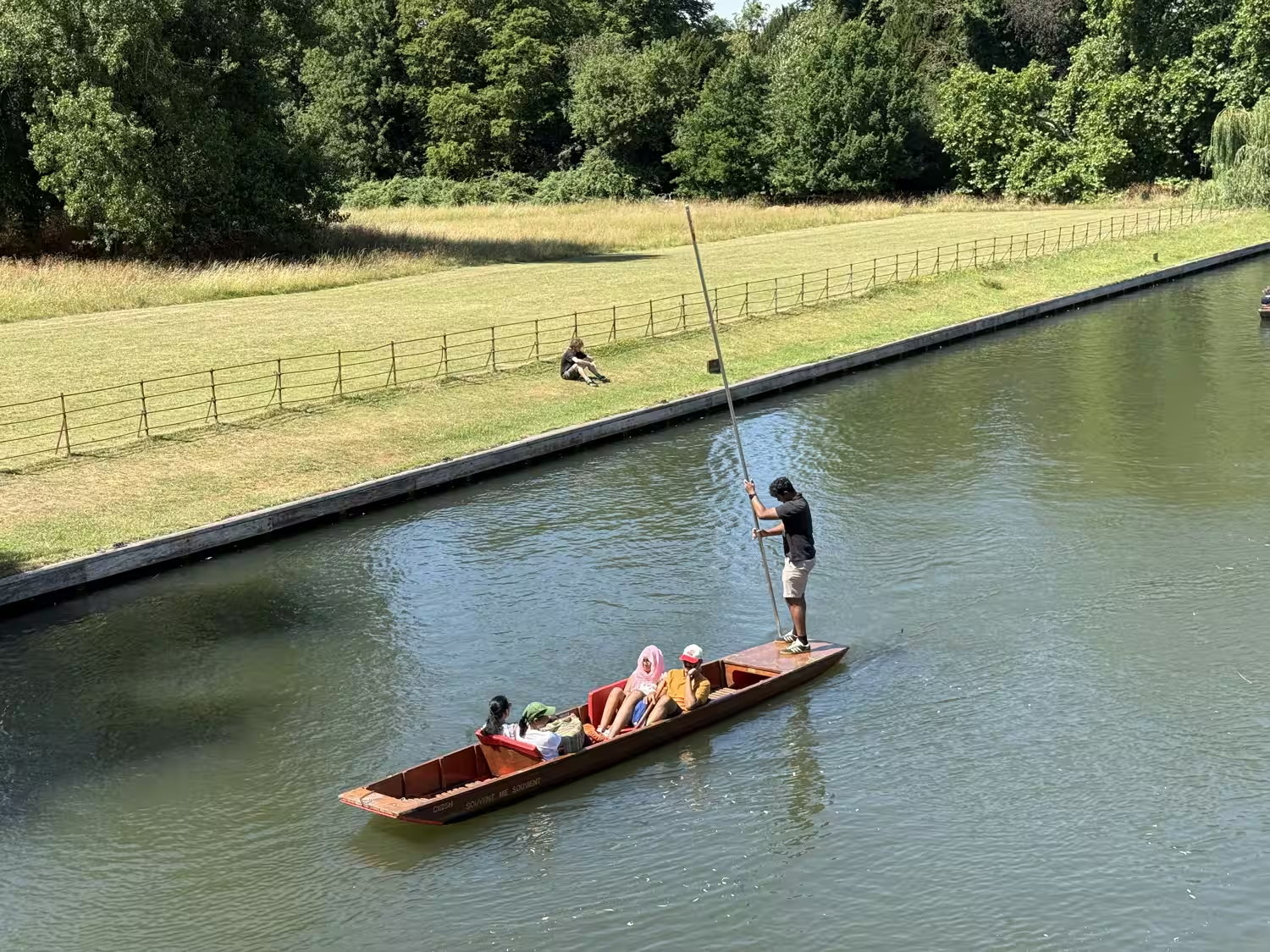
Punting is moving a flat-bottomed, square-ended boat along a shallow river by standing up and pushing a long pole against the riverbed. It is not rowing and not paddling. There are no oars, no engine and no rudder. The boat is called a punt, the pole does the pushing and most of the steering, and the boat glides between strokes. In Cambridge it happens on the River Cam, nearly always along the College Backs behind King's, Clare, Trinity and St John's.
What is punting?
Punting is propelling a flat-bottomed boat along a shallow river by pushing a long pole against the riverbed. You stand up, face forward, drop the pole in until it hits the bottom, and push. The boat carries on gliding while you pull the pole back up for the next stroke. No oars, no paddle, no engine, no rudder.
The description sounds almost too simple, and that is the honest reason the word confuses people. Visitors picture a gondola, or a canoe, or something with an outboard motor on the back. It is none of those. The closest thing in most people's experience is pushing a raft off a lake bed with a stick, except the stick is 16 feet long and the boat is 24.
I have poled the Cam since 2021 and the thing I would tell you before you get in is this: punting is a river-specific skill, not a boating one. It only works where the water is shallow. Put a punt on a lake or a deep river and the pole never reaches anything, and you are just a person standing in a wooden box holding a stick. The Cam is shallow, slow and weedy, which is exactly the water this boat was built for.
What is a punt boat?
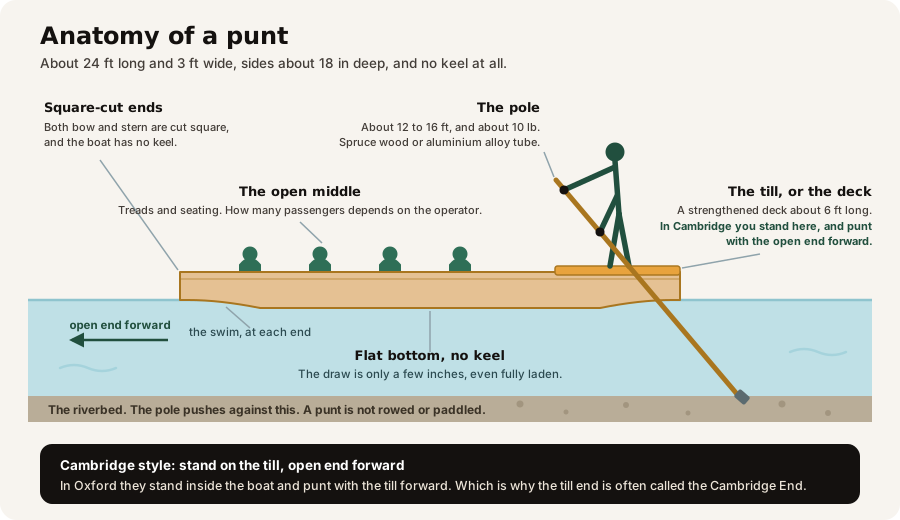
A punt is a flat-bottomed river boat, cut square at both ends, with no keel. A traditional one is about 24 feet long and 3 feet wide, with sides about 18 inches deep. Because there is no keel it draws only a few inches of water even when fully laden. One end has a strengthened deck about six feet long, called the till, and the open middle holds the passengers.
Every one of those features is a response to shallow water. A normal boat has a keel: a fin running down the centre of the hull that keeps it tracking straight. A keel also means depth, and depth means you run aground. The punt gives up the keel entirely and sits on top of the water rather than cutting into it. That is the trade. You lose the automatic straight line, which is why steering a punt is a skill, and you gain the ability to float over a riverbed that is sometimes only a few feet down.
The square ends do the same job from the other direction. A pointed bow buys you speed you do not need on a river with a 4 mph feel to it. A square end buys you carrying capacity and stability for the same length of boat. It is why a punt feels so solid once you stop expecting it to wobble like a canoe. The underside still slopes gently at each end, a long shallow curve called the swim, so the flat bottom does not slam into the water like a plank.
Here is the boat broken into the parts you can actually point at.
| Part | What it is | Why it is like that |
|---|---|---|
| The flat bottom | A keel-less hull that draws only a few inches of water, even fully laden | The Cam is shallow and weedy. A keel would ground you. |
| The square ends | Both bow and stern are cut square rather than pointed | More capacity and more stability for the same length of boat. |
| The swim | The underside slopes gently upward at each end | Lets the flat hull enter the water cleanly instead of slapping it. |
| The till (the deck) | A strengthened deck about 6 ft long at one end | Adds rigidity to a keel-less boat, and in Cambridge it is where you stand. |
| The open middle | Treads and seating along the open body of the boat | Where passengers sit. How many depends on the operator and the boat. |
| The pole | About 12 to 16 ft, about 10 lb, spruce wood or aluminium alloy tube | Long enough to reach the riverbed and push off it. The whole engine. |
Traditional dimensions and construction as recorded by the reference history of the punt. Individual boats vary, because they are built by hand.
What does punting mean in England?
In England, punting almost always means the boating: travelling in a punt by pushing a pole against the riverbed, and it is associated above all with Cambridge and Oxford. There is a second, entirely unrelated British sense of "to punt" meaning to bet or gamble, which is why "a punter" can mean a gambler or just a customer. Context sorts them out instantly.
The boat word is old. It is recorded from around 1500 and probably comes from British Latin ponto, a flat-bottomed boat, which traces back to Latin pons, meaning bridge. So the name has been attached to this shape of hull for roughly five centuries, long before anyone thought of it as a nice way to spend an afternoon.
The gambling sense arrived by a different route and never merged with the boat. Nobody in Cambridge is confused by it. If someone here says they went punting on Saturday, they were on the river. If someone in a betting shop says it, they were not.
Then there is the split that actually matters if you are choosing between the two university cities.
| Cambridge | Oxford | |
|---|---|---|
| Where you stand | On the till, the flat deck at one end | Inside the boat, on the bottom |
| Which end goes first | The open end forward | The till forward |
| The end is nicknamed | The Cambridge End (the till end) | The Oxford End |
| The boat itself | Essentially the same. The difference is in how it is punted, not in what it is. | |
| The river | The Cam, past the College Backs | The Cherwell and the Isis |
Punters from each city will tell you the other city is doing it wrong. Standing on the till gives you a higher platform and a longer reach, and it is also the more exposed place to be, which is where most of the falling-in stories come from. I am not going to pretend it is a matter of physics. It is a habit that hardened into a tradition, and both cities are happy about it.
Why is punting a Cambridge thing?
Because of where the boats happened to launch. The Cam runs directly behind the great colleges, so a punt drops you into the one view of Cambridge you cannot get on foot. The boat is old, but pleasure punting on the Cam is not: traditional Thames-style pleasure punts were not introduced here until roughly 1902 to 1904.
That surprises people, and it should. King's College Chapel was finished in 1515. The punts drifting under it arrived about four hundred years later, in the age of the motorcar. Punting feels medieval and is actually Edwardian. Before that the punt was a working boat, hauling cargo and cutting reeds on English rivers, and nobody would have called an afternoon in one a treat.
What made it stick was geography doing the work. The stretch called the Backs runs behind King's, Clare, Trinity and St John's, and takes in the Bridge of Sighs and the Mathematical Bridge. From the water you see the colleges from the side almost no visitor reaches, and you pass under bridges that people otherwise only walk across. No other English city had that on offer, and once the first companies started hiring boats out, the trade never left.
The full timeline, including who opened first and when, is in our history of punting in Cambridge, with the dates that can be sourced and the ones that cannot. Worth reading before you claim anything at a dinner party.
Book your punt
Ready to get on the River Cam?
Shared, private and student-guided punts run daily along the College Backs. See the live price and free-cancellation terms on the operator's official listing before you pay.
Check live availability & prices →4.7 · 1,521 reviews · free cancellation up to 24 hours
How do you punt?
Stand on the till. Drop the pole straight down into the water, let it touch the riverbed, then push it past your chest. That drives the boat forward. At the end of the stroke, relax and let the pole float up behind you, then recover it hand over hand until you can drop it again. Beginners trail that floating pole like a rudder to steer. Experienced punters steer during the stroke instead, using where they plant the pole.
The steering is the part people get wrong, and it is worth being precise about it, because half the advice online is beginner advice presented as the technique. Dragging the pole behind you as a rudder does work. It also slows the boat, and it means you are correcting a mistake you already made. Punt for a season and you stop doing it. You learn to place the pole slightly off-centre, and to pull it toward you or shove it away during the push, so the boat is aimed before it has gone anywhere.
Two things nobody warns first-timers about. One: the pole gets stuck. The Cam bed is muddy in places, you plant it, you push, and the pole stays where it is while the boat carries on without it. Let go. Every guide on this river has watched someone choose the pole over the boat, and the river always wins that argument. Two: the recovery is the tiring bit, not the push. You are lifting about 10 lb of wet pole out of the water, hand over hand, several times a minute, with your arms above your waist. It is not heavy. It is just relentless.
The reason a good chauffeur makes it look like nothing is rhythm. Drop, push, float, recover, drop. Get the rhythm and the punt tracks straight and you barely feel like you are working. Miss it and you spin gently into the bank in front of two hundred people on the Mathematical Bridge, which is the single most photographed event on the Cam. Our self-hire punting tips go through the whole stroke properly, and what to expect the first time punting covers the rest of it.
Chauffeured or self-hire: which should you choose?
Chauffeured if you came to look at Cambridge. Self-hire if you came to punt. A guide poles, steers and talks you through the colleges while you sit still, and the Backs run takes about 45 to 50 minutes. Self-hire is cheaper per boat, and you will spend your first stretch fighting the pole instead of looking at King's.
That is not a warning against self-hire. I like self-hire. But be honest about which thing you are buying. A punt you are poling yourself demands your full attention on a river that, in high summer, is busy with other people who are also learning. You will get better fast, and you will also miss the Bridge of Sighs entirely because you were reversing away from a hedge when you went under it.
| Chauffeured | Self-hire | |
|---|---|---|
| Who poles | A guide does all of it | You do |
| The Backs run | About 45 to 50 minutes | As long as you take, and you will take longer |
| Commentary | Yes, college by college | None. You are busy. |
| Skill needed | None. Sit down. | Real, and the first stretch is humbling |
| With children | The straightforward option | Hard. Nobody poles well while watching a four-year-old. |
| Best for | A first visit, a short schedule, actually seeing the colleges | A free afternoon and the urge to learn something |
Punting on the Cam runs year-round, every day except Christmas Day, which catches people out in both directions: yes you can punt in February, and no you cannot punt on the 25th of December. Where you set off from decides what you see, and there are only six stations licensed by the Conservators of the River Cam, so start with where to go punting in Cambridge. Formats sit side by side on our comparison page.
On price, we will not quote you a figure here, because punting prices move with the season, the day and the operator. Our Cambridge punting prices guide explains what drives the cost and what a shared seat, a private punt and a self-hire boat are priced against. For the actual number, check the live price on the operator's official listing before you pay. That is the whole of our affiliate relationship and it is set out in our disclosure.
How is punting different from rowing, kayaking or a gondola?
Punting pushes off the riverbed with a pole while you stand and face forward. Rowing pulls against the water with oars while you sit and face backwards. A kayak or a canoe is driven by a hand-held paddle. A gondola is rowed, not poled, with one long oar worked against a carved wooden rest.
Every one of those boats solves a different problem, and the giveaway is what each one asks of the water underneath it. Oars, paddles and propellers all work against the water itself, so they need depth. A pole works against the ground, so it needs the opposite: water shallow enough to reach the bottom of. That single difference explains why punting exists on the Cam and not on a lake.
The gondola comparison comes up on almost every trip, usually from someone who has been to Venice. It is the closest thing in feel, since both are slow, both are steered by one person standing at one end, and both are about looking at buildings from water level. Mechanically they have almost nothing in common. A gondolier rows. A punter pushes off the bed of the river.
| Boat | What moves it | Where you are | What the water has to be |
|---|---|---|---|
| Punt | A pole pushed against the riverbed | Standing on the till, facing forward | Shallow enough for a 12 to 16 ft pole to touch bottom |
| Rowing boat or skiff | Oars pulled against the water, turning in rowlocks | Seated, facing backwards | Deep enough for the blades to bite |
| Kayak or canoe | A hand-held paddle with no fixed pivot | Seated low, facing forward | Almost anything, including lakes and sea |
| Gondola | One long oar worked against a carved wooden rest | Standing at the stern, facing forward | Deep enough that the oar never touches the bed |
| Anything with an engine | A propeller | Seated, hands free | Deep enough to keep the propeller clear |
The point of the table is the last column. Punting is the only one of these that needs a shallow riverbed rather than tolerating one.
It also explains the range of a punt. You cannot punt out of the Cam and keep going, because the water changes character quickly once you leave the stretch the boat was built for. Where each licensed station can actually take you is set out in where to go punting in Cambridge.
What actually happens during a single punt stroke?
A stroke has five parts: drop, plant, push, float and recover. The push is the short bit and the easy bit. The recovery, lifting a wet pole back up hand over hand before the next drop, is what tires people out, and it is where nearly every beginner mistake shows itself.
I have poled the Cam since 2021, and this is the part of punting I would most like visitors to understand before they judge it, whether they are about to take the pole themselves or just watch someone else do it for 45 minutes. From the seat it looks like one continuous movement. It is not. It is five separate things happening in a loop, and the loop only feels effortless when all five land in time.
Watch a good chauffeur and you will notice they barely seem to push at all. That is because the punt is still gliding from the last stroke when the next pole drop goes in, so each push only has to top the boat up rather than start it moving. A beginner lets the punt stop between strokes, then has to accelerate 24 feet of boat from nothing, several times a minute. Same river, twice the work.
| Phase | What you do | What goes wrong |
|---|---|---|
| Drop | Let the pole slide down through your hands, close to the side of the boat | Thrown out at an angle, it pushes you sideways before it pushes you forward |
| Plant | Feel it touch the bed and let it settle for an instant | Soft mud swallows it. That is the pole that stays behind when the boat leaves |
| Push | One smooth push past your chest | A heave rocks the boat and buys almost no extra glide |
| Float | Let the pole trail up behind you while the punt carries on | Gripping a pole that has leaned back past you is how people end up in the river |
| Recover | Bring roughly 10 lb of wet pole up hand over hand, ready to drop again | Rushing it, so the next drop lands late and the line wanders |
| Steer | Beginners trail the pole like a rudder. Experienced punters aim during the push | Stabbing the pole from side to side, which spins the boat |
The stroke as it is taught at the stations and as I pole it. Pole weight and length are the traditional figures given above.
None of this matters if somebody else is holding the pole. It matters a great deal if you are hiring a boat, which is why our self-hire punting tips go through the same six moments in more practical detail.
How long does a punting trip actually take, door to door?
Allow about an hour and a half from arriving at the station to walking away from it, for a trip that spends 45 to 50 minutes on the water. The rest goes on finding the right station, a short wait while the boat resets, and a careful step down into a boat that sits low and shifts as you board.
People plan the water time and forget the edges. Then they book a punt for 2pm, arrive at 1:58, and spend the first ten minutes of a relaxing afternoon walking fast. The edges are short, but they are not nothing.
Boarding is the only genuinely awkward moment of a chauffeured trip, and it is over in a minute. The punt sits low against the bank, it moves a little as weight goes in, and you step down one person at a time rather than as a group. Keep low, take the hand if it is offered, and sit before the next person steps in.
| Roughly when | What is happening | What to do about it |
|---|---|---|
| 15 minutes before your slot | Finding the station and checking in | Only six stations are licensed. Anyone selling on King's Parade or Market Square is not one of them |
| The 5 or 10 minutes before you board | The previous group steps off and the boat resets | A good moment for the toilet, a jumper, and getting the phone secured |
| Boarding, a minute or two | You step down into the punt one at a time | Low, slow, one at a time, and sit as soon as you are in |
| The first five minutes | Push off, and everyone quietly works out the boat is stable | Sit back. The tension goes on its own by the first bridge |
| 45 to 50 minutes | The Backs: around seven colleges and nine bridges, with the commentary | Have the camera ready before King's. The punt does not stop for photos |
| Stepping off | Back at the same station you left from | Nothing to collect, nothing to return. You simply walk away |
Planning guidance based on how the shared Backs trips run, not a published timetable. Station hours and slot times move with the season, so check your booking for the day.
Self-hire runs on a different clock entirely, because you are charged by the hour for the boat rather than for a fixed route, and the hour starts when you push off rather than when you get good at it.
Who should take a chauffeured punt, and who should skip it?
Take a chauffeured punt if you came to look at Cambridge, if you have children with you, if you are short of time, or if this is your first visit. Choose self-hire instead if you came for the doing rather than the seeing. Skip punting entirely if you want speed, or cannot sit still for an hour.
That last row is the one nobody prints, so here it is plainly. Punting is slow on purpose. There is no thrill in it, no spray, no moment where the engine opens up, because there is no engine. If that sounds like a criticism, it is not the boat for you, and there is a perfectly good free footpath along the Backs instead.
For everyone else the question is not whether, it is which format. Here is how I would match them.
| If this is you | What suits you | The reason |
|---|---|---|
| First visit, one afternoon in Cambridge | A shared chauffeured tour | The commentary is most of the point, and it is the best value seat on the water |
| With small children or a baby | A private chauffeured punt | No fixed minimum age on the chauffeured boats, and any child of 16 or under needs an adult beside them anyway |
| Watching every pound | The student-guided shared seat | Usually the lowest-priced seat, poled by a Cambridge student |
| A date, a proposal, a birthday | A private punt | Priced per punt rather than per head, so you are buying the whole boat and the quiet |
| A confident group with a free afternoon | Self-hire | Cheaper per boat and genuinely good fun, once the first twenty minutes are behind you |
| Wanting hours on the water rather than colleges | Self-hire upriver toward Grantchester | Roughly two to three hours of punting each way, through meadows instead of stone |
| After speed or a thrill | Skip it | A punt glides. That is the entire product |
| Unable to sit still for 45 minutes | Walk the Backs footpath instead | Free, on your own timing, and you still get the colleges from across the water |
Planning guidance rather than operator policy. Age rules, capacity and life-jacket availability vary between companies, so confirm with the one you book.
If you land in the family row, our punting with kids guide covers buggies, life jackets and the ages that do best on the water. If you land in the self-hire row, read the self-hire tips before you pay a deposit.
What is punting: FAQ
What is punting?
Punting is moving a flat-bottomed boat along a shallow river by standing up and pushing a long pole against the riverbed. It is not rowing and it is not paddling. There is no engine, no oar and no rudder. The pole does the pushing and most of the steering, and the boat glides between strokes. In Cambridge it is done on the River Cam, usually along the College Backs behind King's, Clare, Trinity and St John's.
What is a punt boat?
A punt is a flat-bottomed river boat cut square at both ends, with no keel. A traditional punt is about 24 feet long and 3 feet wide, with sides about 18 inches deep. Because there is no keel, it draws only a few inches of water even when fully laden, which is what lets it work a shallow, weedy river like the Cam. One end has a strengthened deck about six feet long called the till, and the open middle holds the passengers.
What does punting mean in England?
In England, punting normally means the boating activity: travelling in a punt by pushing a pole against the riverbed, most associated with Cambridge and Oxford. The word for the boat is recorded from about 1500 and probably comes from British Latin ponto, a flat-bottomed boat, from Latin pons meaning bridge. There is a separate and unrelated British sense of "to punt" meaning to bet or gamble, which is why "a punter" can mean a gambler or simply a customer. Context tells you which one is meant.
Is punting different in Cambridge and Oxford?
Yes, in one specific way: which end you punt from. In Cambridge most punters stand on the till, the flat deck at one end, and punt with the open end of the boat forward. In Oxford they stand inside the boat and punt with the till forward. The difference is real enough that the till end is often called the Cambridge End and the other the Oxford End. The boat itself is essentially the same.
How do you punt a boat?
Stand on the till, drop the pole vertically into the water and let it touch the riverbed, then push it past your chest to drive the boat forward. At the end of the stroke, let the pole float up behind you and recover it hand over hand until you can drop it again. Beginners trail that floating pole like a rudder to steer. More experienced punters steer during the stroke itself, using where they plant the pole rather than dragging it afterwards.
Is punting the same as rowing?
No. Rowing pulls against the water with oars while you sit down and face backwards. Punting pushes against the riverbed with a pole while you stand up and face forwards. A punt has no oars, no rowlocks and no keel. That is also why punting only works where the water is shallow enough for a 12 to 16 foot pole to reach the bottom.
Should you take a chauffeured punt or hire one yourself?
Take a chauffeured punt if you want to look at Cambridge rather than at the pole. A guide poles and steers, gives the commentary, and the College Backs run takes about 45 to 50 minutes. Self-hire is cheaper per boat and more fun if you actually want to learn, but the first stretch is genuinely hard and you will spend it steering rather than sightseeing. For a first visit, with children, or on a tight schedule, chauffeured is the easier call.
Ready to get on the water?
Start with the most-booked option: a shared chauffeured punt along the Backs, past King's, the Bridge of Sighs and the Mathematical Bridge, with the live price and cancellation terms shown before you pay.